
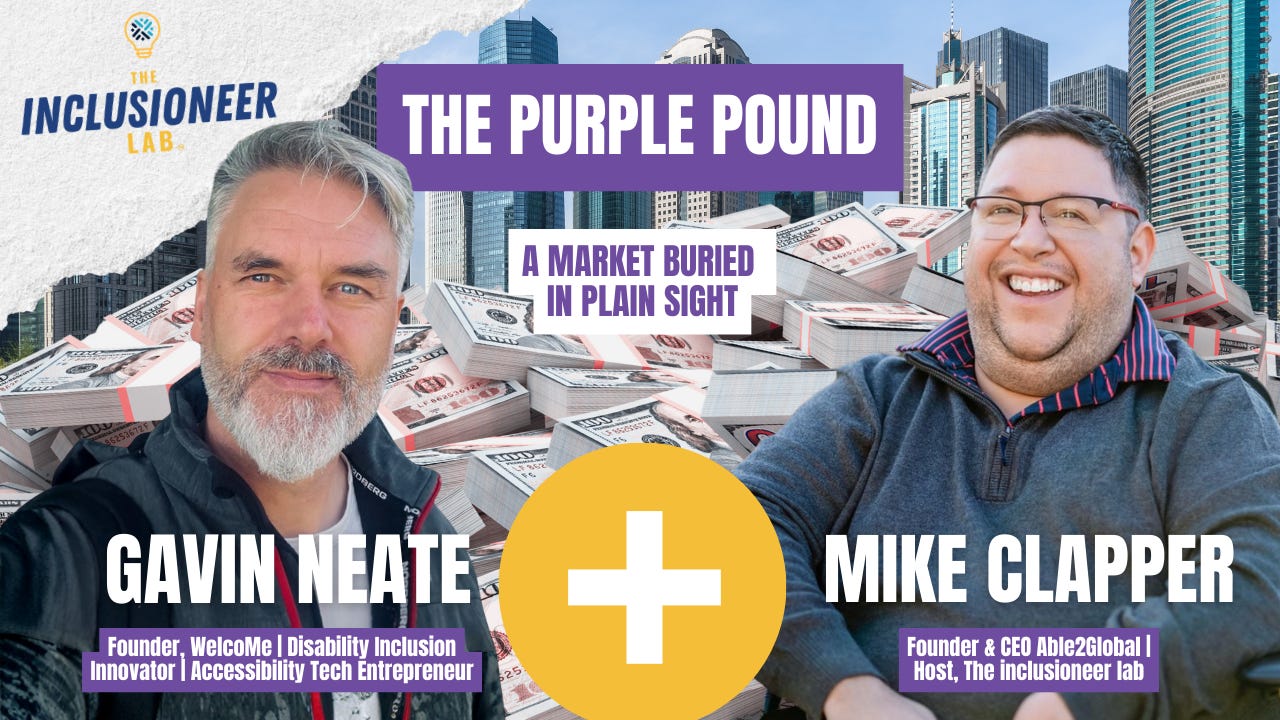
Some conversations don’t feel like interviews.
They feel more like mirrors.
That’s what this one with Gavin Neate turned into.
We’ve known each other for a while. Connected through LinkedIn. Different countries, but the same frustration. The same conviction. The same stubborn belief that accessibility isn’t a “nice to have,” and it sure as hell isn’t charity.
This isn’t charity.
It’s business, real business, and it lives or dies on systems.
And right now, the systems are broken.
So we finally hit record and let the conversation go where it needed to go.

The Purple Pound and the Market Everyone Ignores
In the UK, they call it the Purple Pound.
It’s the collective spending power of disabled people, along with the friends, families, and companions who travel, shop, dine, and make decisions with them.
Globally, that number is estimated in the trillions.
In the UK alone, the number is a staggering £446 billion annually.
And here’s the part that should make every hospitality leader at least a little uncomfortable.
“If that money were buried six feet under a field somewhere, companies would be lining up with excavators before sunrise.”
But because it’s tied to disability, things slow down.
It requires different assumptions. It forces design decisions instead of default choices.
So we hesitate. We defer. We leave it where it is.
That’s not a moral failure. It’s a strategic one.
Empathy Isn’t the Problem. Execution Is.
This line keeps showing up in my life for a reason.
Most people care, most brands genuinely mean well, and most staff members want to do the right thing.
But care doesn’t scale. Systems do.
You can care deeply and still deliver a broken experience. You can be compliant and still fail your guests. You can apologize sincerely and still strand someone on a ship, in a hotel room, or at the front desk with no real way forward.
“Good intentions don’t survive broken systems.”
Gavin put it plainly.
We’ve spent decades talking about what is wrong.
We’ve written endlessly about why it’s wrong.
What’s missing is the commitment to design and fund the how.
And the people who absorb that gap aren’t the executives.
It’s the guests.
The Hidden Cost Nobody Sees
Here’s something we don’t talk about enough.
The disabled travelers you see are the tip of the iceberg.
They’re the ones who’ve learned how to navigate discomfort. They’ve practiced self-advocacy. They’ve absorbed awkward moments and kept moving.
But underneath that surface is a much larger group of people who simply stop showing up.
They stop traveling. Some stop going out altogether. And over time, they stop trusting that the effort will be worth it, that the friction won’t outweigh the experience.
“The most expensive accessibility failures don’t show up as complaints. They show up as absence.”
Every time that happens, revenue quietly disappears.
No complaint. No viral post.
Just a booking that never gets made.
Hidden revenue leaks.
Why Training Keeps Failing
One of the most important parts of our conversation wasn’t about money at all.
It was about memory.
Traditional training assumes that if you tell someone something once, they’ll remember it forever.
They won’t.
Most people forget the majority of what they’re taught within days. Add staff turnover, high-pressure environments, and competing priorities, and suddenly your “inclusive training program” becomes a binder on a shelf.
Gavin’s insight was simple and disruptive.
“Training shouldn’t be static. It should show up right before the guest does.”
Not once a year. Not in theory.
In the moment it actually matters.
What Happens When the Guest Is in Control
This is where his work with Welcome really clicked for me.
Imagine a world where a guest doesn’t have to explain themselves at the front desk.
Where they don’t brace for the blank stare. Where they don’t hope the one staff member who “gets it” happens to be on shift.
Instead, the system already knows they’re coming. The staff member already knows how to help. The interaction starts with confidence instead of tension.
“Certainty is one of the most underrated forms of hospitality.”
And that certainty doesn’t just help one group of guests.
It helps wheelchair users. It helps blind and deaf guests. It helps neurodivergent travelers, people with epilepsy, parents, and aging travelers.
When the system works, everyone feels it.
From Dependence to Independence
One of Gavin’s stories stuck with me.
A young person with a disability shopping for shoes.
Without support, the parent does all the talking. The transaction happens around the person, not with them.
With the right system in place, the staff member is prompted to speak directly to the customer.
The result isn’t flashy.
Confidence shows up.
Autonomy shows up.
And dignity follows naturally.
“Good accessibility doesn’t just remove barriers. It creates belief.”
A parent stands back, realizing their child can navigate the world more independently than they thought.
That’s not just good service.
That’s life-changing.
Data Is the Missing Link
There’s a quiet revolution hiding in all of this.
When guests communicate their needs in advance, something else happens.
Data appears.
Not marketing data.
Not research that lives in a drawer.
Operational truth.
Who your guests actually are, what they actually need, and here investment will actually matter.
“When you stop guessing, inclusion stops being expensive.”
You stop building for optics.
You start building for impact.

This Isn’t About Doing More
It’s about doing things differently.
Accessibility isn’t about adding friction. It’s about removing it.
This isn’t about special treatment or guilt. It’s about thoughtful systems, and the kind of growth that follows when friction disappears.
Because the brands that figure this out don’t just serve disabled guests better.
They serve everyone better.
The Question That Lingers
So here’s the question I can’t get away from.
We already know the market is big. We know these guests come back, and they rarely travel alone.
The tools aren’t theoretical anymore. The data exists. The systems work. We’ve seen it.
So why do we still treat accessibility like a “nice to have”?
“The money isn’t hypothetical. The guests aren’t edge cases.”
What’s missing isn’t proof.
It’s movement.
We’re just not digging.
And the brands that finally do?
They won’t just win market share.
They’ll reset expectations.
Watch or listen to the full episode on Spotify or Youtube
Follow us on social media
@able2global | @inclusioneerlab
Learn more at
able2global.com