
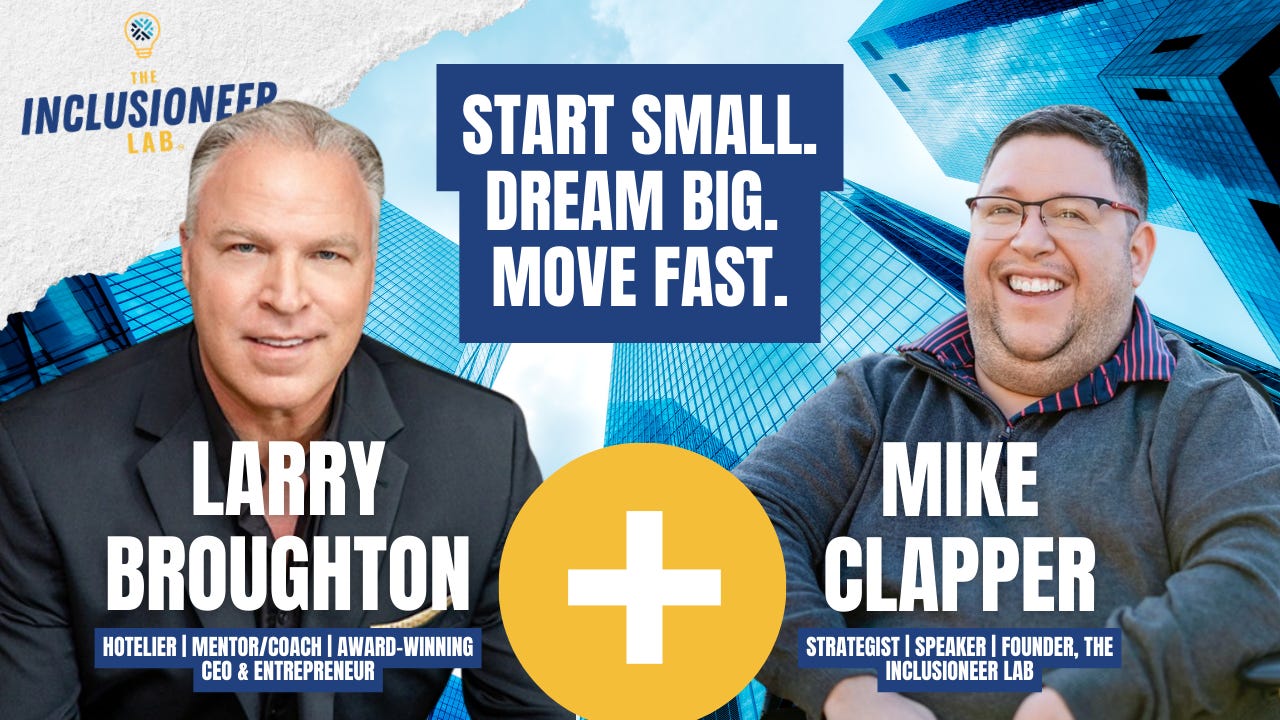
About a year ago, I came to a humbling realization…I needed a mentor.
Not a hype guy.
Not a guru.
Not someone with all the answers.
A sage. Think Mr. Miyagi from The Karate Kid.
Not because I was new to hospitality, but because I knew this work required perspective, not momentum.
That’s when I met Larry Broughton. Green Beret. Boutique hotel owner. Leadership coach. A man who’s made his mistakes in public and learned from every one of them, and someone who has quietly shaped more hospitality careers than most people realize.
After months of meaningful private conversations, I invited Larry onto The Inclusioneer Lab podcast. The episode wasn’t about war stories or résumés. It was about legacy, execution, and the quiet ways the hospitality industry keeps leaking revenue while thinking it’s doing just fine.
If you lead a hotel, restaurant, cruise line, or any guest-facing operation, this conversation will feel familiar.
How Real Innovation Actually Happens (But Not Recklessly.)
Larry has a mantra he’s been using for years:
Start small. Dream big. Move fast.
At first glance, it sounds like a motivational slogan you’d see on a hoodie. But when he explained it, the logic became clear.
Starting small isn’t about thinking small. It’s about testing ideas in the real world before you bet the farm. Small pilots. Real guests. Fast feedback.
Dreaming big means holding the long view. Seeing the full potential of an idea, not just the first version, while you experiment in the short term.
And moving fast doesn’t mean cutting corners. It means learning quickly, while you still have room to adapt.
Larry illustrated this by talking about converting old mid-century motels into boutique hotels, what he coined as “Motiques.” At the time, it was politely dismissed by most, naïve at best, unnecessary at worst.
Today, it’s gaining real traction across the industry.
The insight wasn’t about motels. It was about where innovation actually happens.
Not in massive brands.
Not in boardrooms.
But in smaller, more flexible environments where experimentation is allowed and failure doesn’t end careers.
Customers Are Transactional. Clients Are Relational.
Larry made another distinction I loved, one that quietly exposes why so many well-intentioned hospitality teams still fall short.
Customers are transactional.
Clients are relational.
Hospitality should be building clients.
Clients come back.
Clients bring their families.
Clients forgive mistakes when trust is there.
Clients tell other people.
And here’s the part too many leaders miss. Guests with accessibility needs are often among your most loyal potential clients when you get it right. Longer stays. Larger travel parties. Higher lifetime value.
When you get it wrong, they don’t always complain.
They just disappear quietly, along with their loyalty and their revenue.

Collaboration Beats Silos. Every Time.
One of the most practical moments in the episode was Larry’s breakdown of design charrettes.
Get everyone in the room. Not sequentially. Together.
Design. Operations. Finance. Sales. Marketing.
One day. Sometimes two.
Larry said something that stuck with me:
“We forget the power of collaborative success.”
Because the sexiest design in the world doesn’t matter if it doesn’t function. And the most efficient financial model collapses if guests hate the experience.
Decisions get made in isolation. Teams optimize for their lane. And the guest, especially the edge-case guest, gets lost in the process.
This is where I see hidden revenue leaks every week. You can spend millions renovating a property and still miss the guest.
Not because people don’t care, but because no one is empowered to connect the dots early, before concrete is poured and decisions harden.
Compliance Is the Floor. Not the Ceiling.
We spent a lot of time talking about accessibility, but not in the way most people expect.
Not checklists.
Not grab bars.
Not “Are we ADA compliant?”
Larry admitted something that takes humility. Over dozens of hotel projects, he had hired ADA consultants to ensure compliance. He had rarely brought in people with lived experience to make sure a space actually works.
That distinction matters.
When accessibility is treated as a box to check, the result is often a technically compliant room that feels punitive. Furniture removed. Layouts stripped down. Dignity unintentionally lost.
And here’s the uncomfortable truth. That’s not just bad ethics. It’s bad business.
There are over 100 billion dollars in travel spending tied to travelers with disabilities each year. Much of it is quietly underserved or avoided because the industry still treats accessibility as risk instead of opportunity. That figure doesn’t even include the aging population, which every hotel will serve whether they plan for it or not.
Larry framed it perfectly:
“Most of us will eventually fall under the ADA as we age. So why wouldn’t we design for that now?”
Designing for the margins almost always improves the experience for everyone.
Boutique Hotels Are Still the Industry’s R&D Lab
One of my favorite threads in the conversation was Larry’s reminder that many of the things we now take for granted started in independent hotels.
Electronic door locks.
Touch-tone phones.
Design-forward guest rooms.
Boutique branding itself.
None of that started with the big brands.
And the same is true now.
If universal design, inclusive guest experience, and smarter systems are going to evolve, it will start with operators willing to test, learn, and lead, not wait.
That’s not just good ethics. That’s competitive strategy.